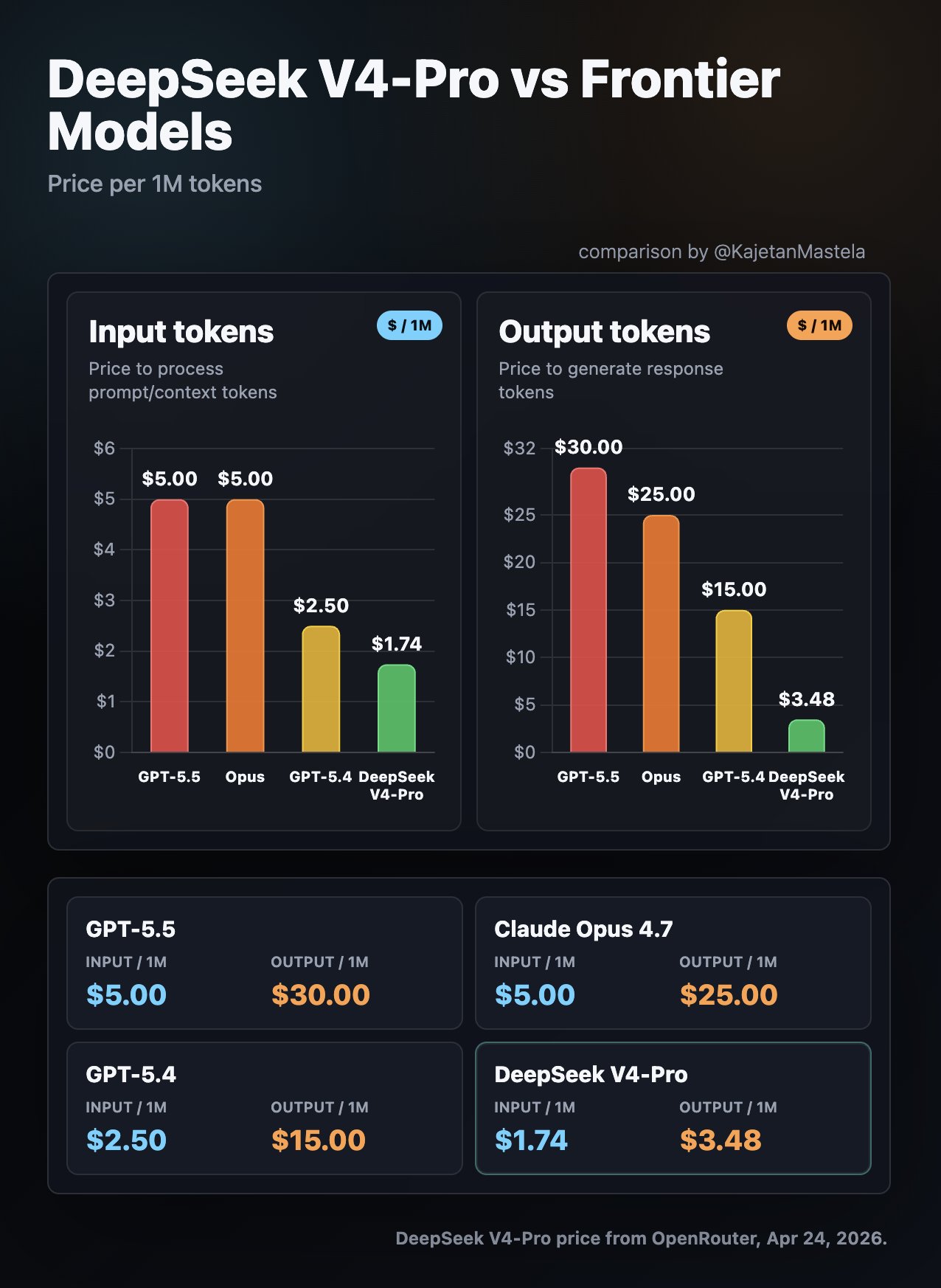
According to a tweet by Kajetan Mastela, OpenAI’s upcoming GPT‑5.5 will cost $5 per million input tokens and $30 per million output tokens—exactly double the $2.50/$15 rates of GPT‑5.4. By contrast, DeepSeek V4‑Pro is listed at $1.74/M input and $3.48/M output, making it appear dramatically cheaper.
The headline numbers
DeepSeek’s pricing is roughly one‑third of GPT‑5.4’s input cost and less than 10 % of its output cost. OpenAI’s GPT‑5.5, meanwhile, jumps to $5/M input and $30/M output, while the Opus 4.7 model sits at $5/M input and $25/M output. The widening gap suggests a pricing arms race among LLM providers.
How the costs compare in practice
For a typical startup workload—say 10 M input tokens and 5 M output tokens per month—DeepSeek would cost about $17, whereas GPT‑5.5 would run roughly $200. Even Opus 4.7 would be $125. Those differences can quickly affect budgeting decisions, especially when scaling.
Caveats and trade‑offs
Price isn’t the only metric. DeepSeek’s performance claims are “very strong,” but independent benchmarks are limited, and the model may generate more false positives in niche domains. OpenAI’s higher price often comes with broader ecosystem support, better safety tooling, and more mature documentation. Startups should weigh the risk of reduced reliability against the immediate savings.
When to try DeepSeek
If your product is token‑heavy and you can tolerate a modest dip in model maturity, experiment with DeepSeek on a low‑traffic feature and compare latency, quality, and cost against a baseline GPT‑5.4 integration. Keep an eye on the pricing announcements for GPT‑5.5 and Opus 4.7, as shifts could alter the calculus before committing to a long‑term contract.