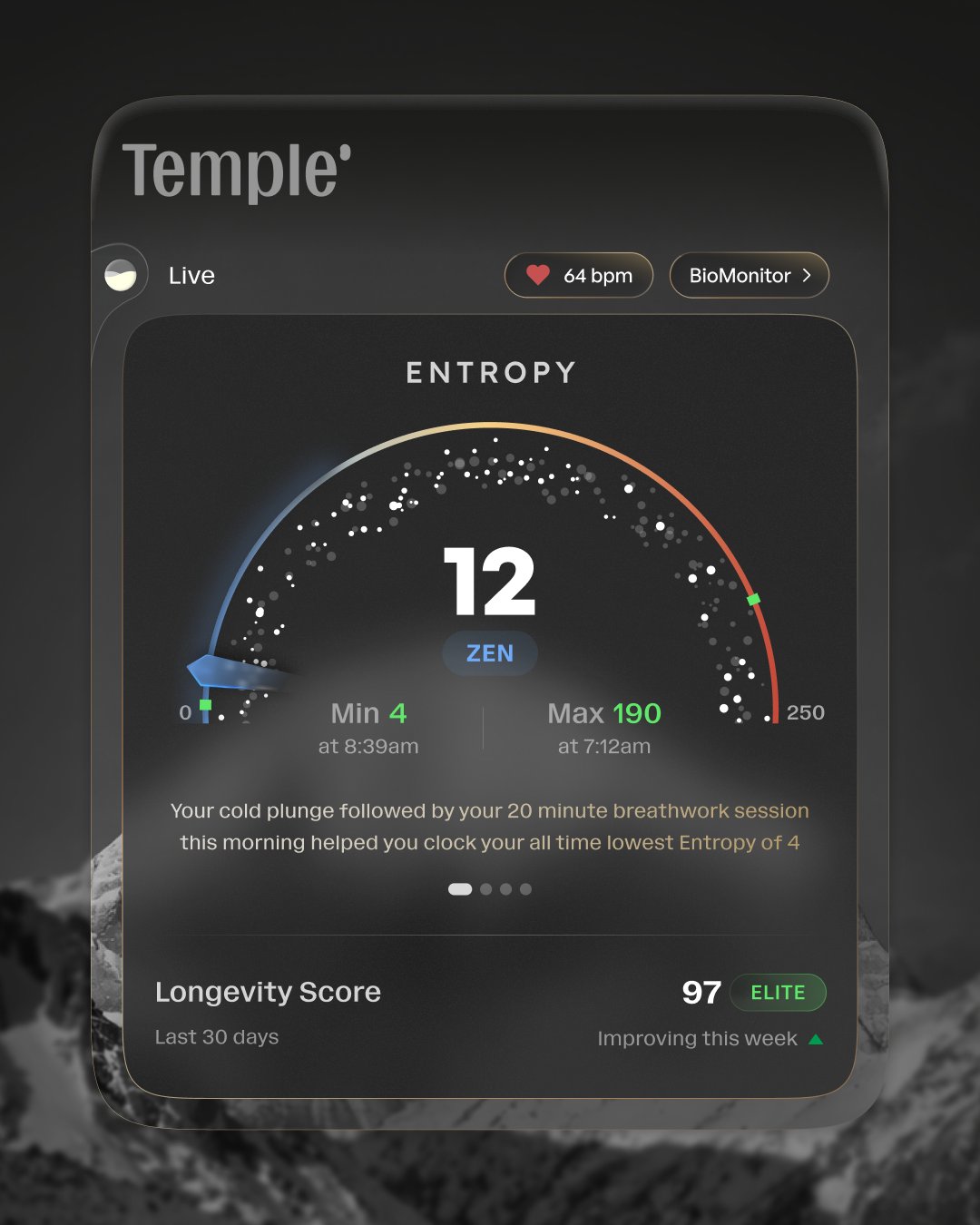
Temple announced today that its new Entropy™ metric is live on the app’s home screen, showing a real‑time index from 1 to 250 that updates every second — the first publicly visible number that claims to measure the "cost of being alive" in real time 【https://x.com/i/status/2067578443047596141】.
What Entropy claims to measure
Entropy is presented as a biomarker readable only from the "temple" region of the body. The score supposedly reflects how much metabolic energy you’re expending at any moment. A low reading (≈1) is associated with deep meditation, while a high reading (≈250) appears during elite athletic output. The metric is displayed on the Temple home screen, refreshing each second, so users can watch the curve shift with coffee, workouts, or a cold plunge.
How it stacks up against heart rate
In a benchmark of over a hundred cardio sessions, Entropy’s correlation with a gold‑standard metabolic cart was reported as r=0.93 (p < 0.001), whereas heart rate only achieved r=0.55. If those numbers hold, Entropy could offer a more direct proxy for caloric expenditure than typical HR‑based estimates. However, the study size is modest and limited to cardio, so it’s unclear how the metric behaves during strength training or sleep.
Access and pricing signals
Temple is currently accepting applications for early access via its website http://temple.com. No pricing tier is disclosed; the tweet implies a “look‑and‑feel” phase before a commercial launch. Startups should assume the eventual product may be subscription‑based, especially if it relies on proprietary hardware or data pipelines.
Skepticism and practical limits
The claim of a “live number” hinges on continuous sensor contact at the temple, which may require a dedicated wearable or phone‑mounted device not described in the announcement. Early adopters could face noisy data, false positives, or integration friction with existing health‑tracking stacks. Moreover, the metric’s scientific validation is still emerging, so building core product decisions around it could be risky.
When to try it – If your team is experimenting with bio‑feedback loops or wants to prototype a feature that reacts to metabolic stress, sign up for the early access and run a short side‑by‑side test against your current heart‑rate data. Treat Entropy as an experimental signal rather than a production‑grade KPI until broader validation and pricing details emerge.