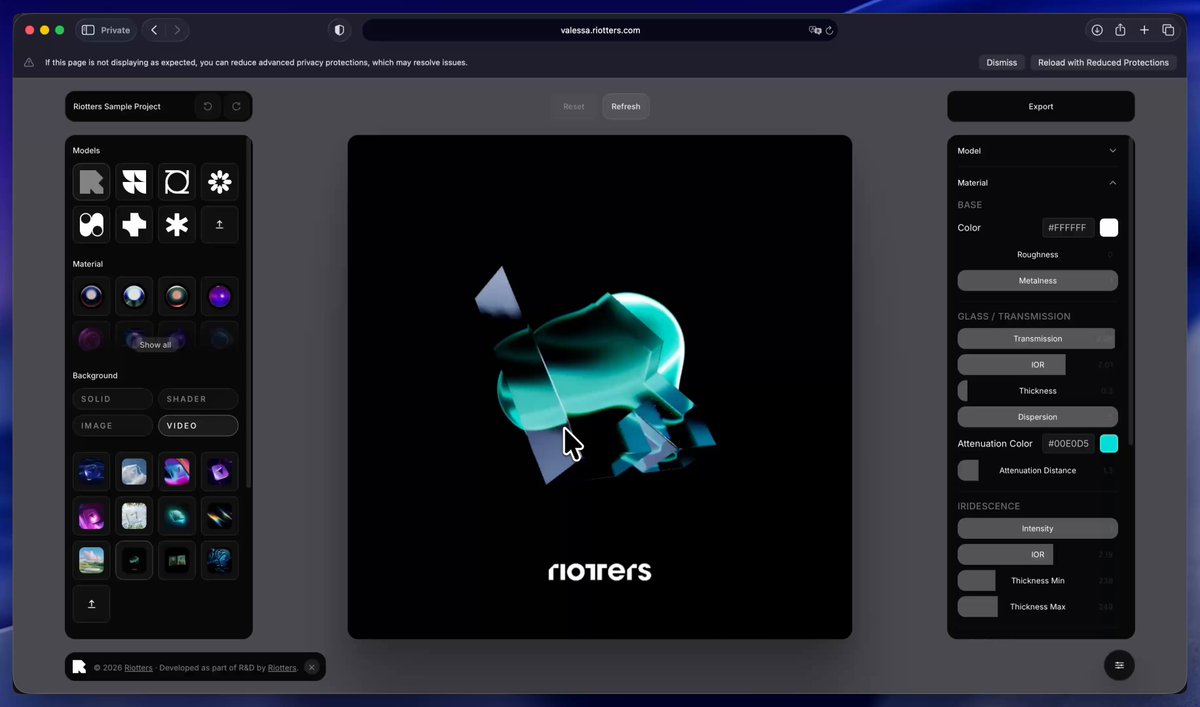
Valessa now lets you drop an SVG into a web page and get a 3D glass model back in under a second. The service is fully free, requires no installation, and runs completely in the browser — see the demo at the official site valessa.riotters.com.
Quick look at the workflow
The tool accepts any SVG file via a drag‑and‑drop interface. Internally it parses the vector data, extrudes it into a mesh, and applies a simple glass material using WebGL. The whole pipeline is powered by three.js, so the output can be rotated, zoomed, and inspected directly in the browser.
What you actually get
- Instant preview – The 3D model appears within a second, making it easy to iterate on designs.
- Export options – You can download the mesh as a GLTF file for further processing in your own pipelines.
- Zero cost – There is no paid tier; the service is publicly available at no charge.
Caveats to keep in mind
Valessa is a proof‑of‑concept rather than a production‑grade asset pipeline. It only supports basic SVG features; complex gradients, filters, or text‑on‑path may be ignored or cause malformed geometry. Because the rendering runs in the client’s browser, performance can vary on low‑end devices, and large SVGs may cause noticeable lag. Finally, the service is hosted by a small team, so uptime isn’t guaranteed for mission‑critical workloads.
When to give it a spin
If your startup needs a fast way to prototype 3D glass assets from existing SVG icons—say for a product demo or internal UI mockup—Valessa is worth a quick test. For production pipelines that require high‑fidelity materials, batch processing, or guaranteed SLA, you’ll likely need a more robust solution.
What to watch: Keep an eye on the tool’s GitHub (if announced) or the developer’s X account for updates, especially around performance tweaks or added export formats.