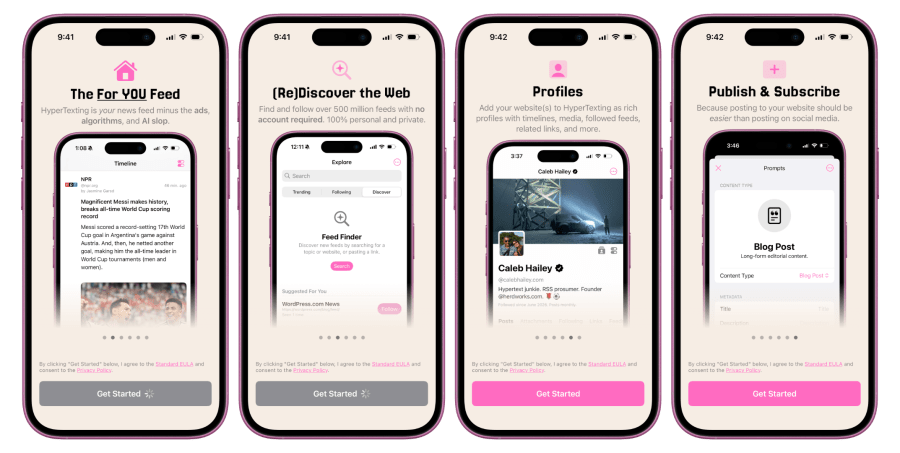
Social media feeds are increasingly dominated by algorithms, ads, and AI-generated content. HyperTexting takes a different approach by turning the open web into a familiar, scrollable feed where you follow websites instead of platforms. Built on RSS, the app lets users browse blogs, newsletters, podcasts, and creator websites in one chronological timeline while giving creators an easier way to publish directly to their own websites.
How the HyperTexting app works
HyperTexting aggregates content from millions of RSS feeds and displays everything in a clean, social media-style interface. Instead of opening multiple apps or bookmarking dozens of websites, users can subscribe once and receive updates in a single feed.
The app also includes an Explore section for discovering new creators and websites, along with a Safari extension that lets users subscribe to a site while browsing. Unlike traditional social platforms, HyperTexting doesn't rely on recommendation algorithms, meaning your feed is shaped entirely by the sources you choose to follow.
For creators, the app doubles as a publishing tool. If you own a website built with platforms like WordPress, Ghost, or Hugo, you can publish new posts directly from HyperTexting, allowing your website to become your primary publishing platform instead of relying solely on social networks.
What you need to use it
HyperTexting is currently available as a free app for iPhone. Getting started is straightforward—you simply install the app and begin following websites, blogs, newsletters, and podcasts that interest you.
If you want to publish content through the app, you'll need your own website connected to one of the supported publishing platforms. While the core experience is free today, the company has indicated it may introduce premium features or limited sponsored content in the future.
Why HyperTexting is different from traditional social media
Most social networks decide what you see through recommendation algorithms designed to maximize engagement. HyperTexting removes that layer completely.
Your timeline is presented in reverse chronological order, making it easier to keep up with the creators and websites you intentionally follow. There are no viral trends interrupting your reading experience, and content ownership remains with the original publisher rather than the platform.
This approach makes HyperTexting feel closer to the early web, where users subscribed directly to websites instead of depending on centralized platforms to surface content.
Potential drawbacks
The experience comes with trade-offs. Discovery is more intentional since there isn't an algorithm constantly recommending new creators. Users accustomed to endless personalized feeds may initially find the platform quieter.
The app also depends on RSS. Websites that don't publish RSS feeds won't automatically appear, and creators who want to publish directly need to maintain their own website instead of posting exclusively on social platforms.
Because the product is still new, features, supported publishing platforms, and pricing could evolve as adoption grows.
Who should try HyperTexting?
HyperTexting is particularly useful for:
- Readers who follow blogs, newsletters, and independent publications.
- Developers and researchers who want to monitor multiple websites from one place.
- Writers and creators looking to build an audience on their own domain.
- Anyone searching for an algorithm-free alternative to traditional social media.
- Users who prefer chronological feeds over engagement-driven timelines.
Should you try HyperTexting?
If you're looking for a cleaner way to consume content without recommendation algorithms deciding what appears in your feed, HyperTexting offers an interesting alternative. It combines the simplicity of social media with the openness of RSS, making it easier to discover, follow, and publish content across the web.
While it's unlikely to replace mainstream social platforms overnight, HyperTexting demonstrates how the open web can deliver a modern social experience without sacrificing user control or creator ownership.