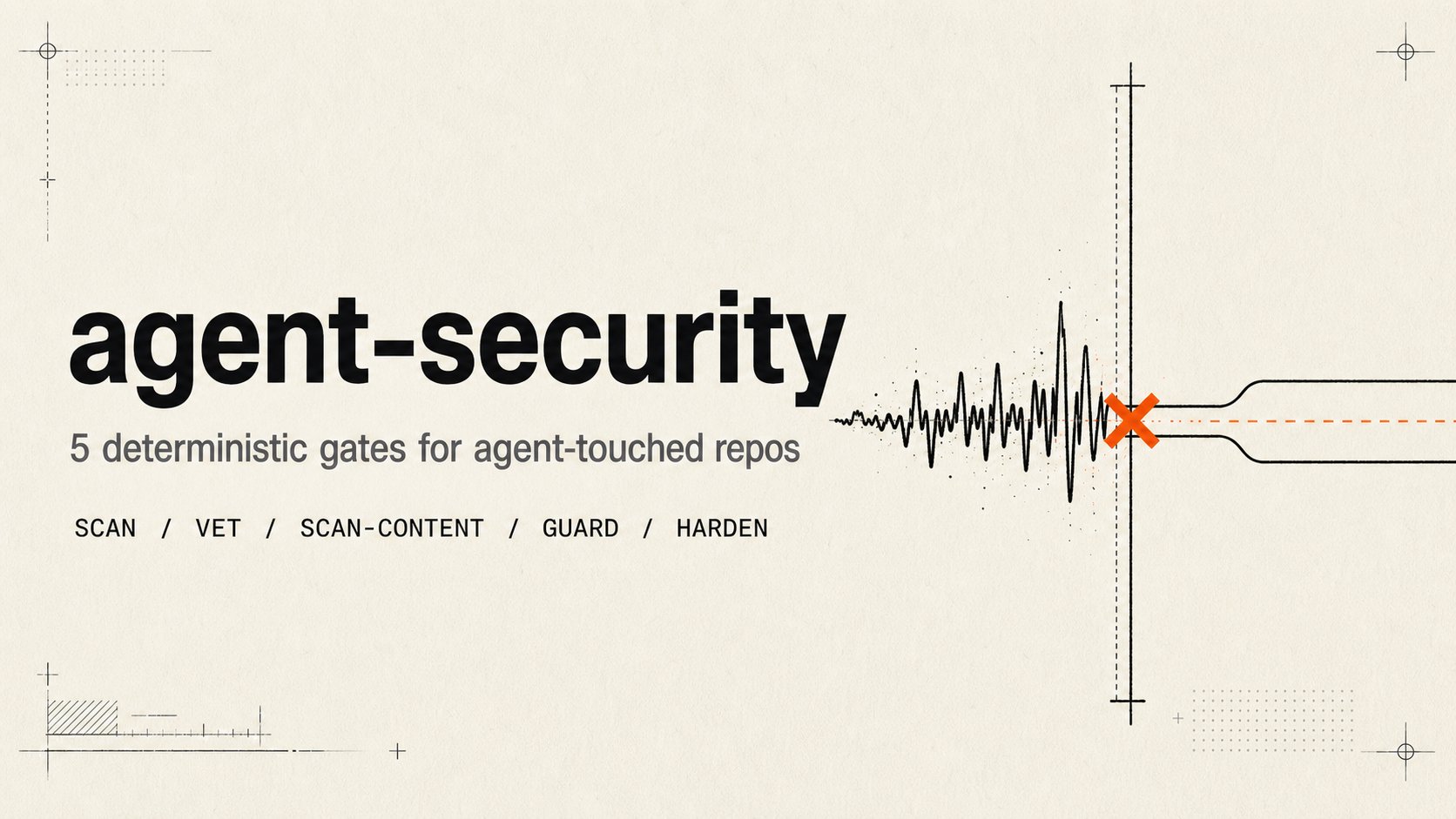
Nyk 🌱 announced the open‑source release of agent‑security today, a tiny CLI that ships five distinct controls – for example, the scan command that inspects a repository for credential patterns, private paths, invisible Unicode, and same‑file decode‑to‑exec signatures. The repo is MIT licensed and includes offline fixture suites, ShellCheck, and Gitleaks integrations.
What the tool does
scanruns a fast static check before publishing code, flagging known secret shapes and obscure encodings.vetevaluates incoming templates, packages, or plugins without executing them, returning ADOPT, REVIEW, or REJECT.scan-contentadds a prompt‑injection guard for fetched pages, pasted text, and tool output, tripping on known instruction‑override or credential‑solicitation patterns.guardintercepts destructive GitHub CLI (gh) actions – delete, transfer, rename, archive, visibility changes – and forces explicit confirmation for the exact repository.hardenaudits the remaining attack surface after local guards fail, checking whether the active GitHub token and server‑side policy could still delete a repo. It reports UNKNOWN instead of a false green check.
Trade‑offs and limitations
The project is transparent about what regex‑based checks cannot prove. Novel wording, encoding tricks, or multi‑line instruction splits can evade scan-content. Cross‑file code flow still requires a dedicated taint‑analysis tool such as CodeQL. A direct API client can bypass the guard layer, so you still need broader token‑scoping policies. In short, the CLI reduces low‑hanging‑fruit attacks but is not a replacement for full‑stack security tooling.
How to try it
Clone the repo, run the one‑minute quickstart (./agent-security quickstart), and observe the output on a test repository. If the scan passes cleanly, you have a baseline of known‑pattern safety; if it trips, treat the report as a prompt to tighten the boundary you expose to coding agents.
What to watch
Monitor the upstream repo for new control additions and for community‑submitted patterns that extend the prompt‑injection database. When you start using AI‑driven agents in CI/CD, run agent-security vet on every new plugin before it reaches production.