Moonshot AI released Kimi K3 on July 16, 2026—a 2.8-trillion-parameter open-weight model that immediately triggered comparisons to Claude Fable 5. The headlines suggested a Sputnik moment: China's largest open-source model now challenges Anthropic's most advanced public model. But the reality is more nuanced, and the controversy around K3's performance claims matters more than the benchmarks suggest.
This analysis examines what the data actually shows, what questions remain unanswered, and why open-weight matters more than raw capability numbers.
What the Benchmarks Actually Show
Kimi K3 and Claude Fable 5 share 14 published benchmarks. Fable 5 wins 8; K3 wins 6. On the surface, this looks like a clear Fable 5 edge. But the split is workload-shaped, not a clean victory.
K3 wins on Frontend Code Arena (#1 ranking) and Terminal-Bench 2.1 (88.3% vs Fable's 84.3%), where long-horizon agentic work and autonomous coding dominate. Fable 5 wins on visual reasoning and professional knowledge work, where reliability matters more than speed.
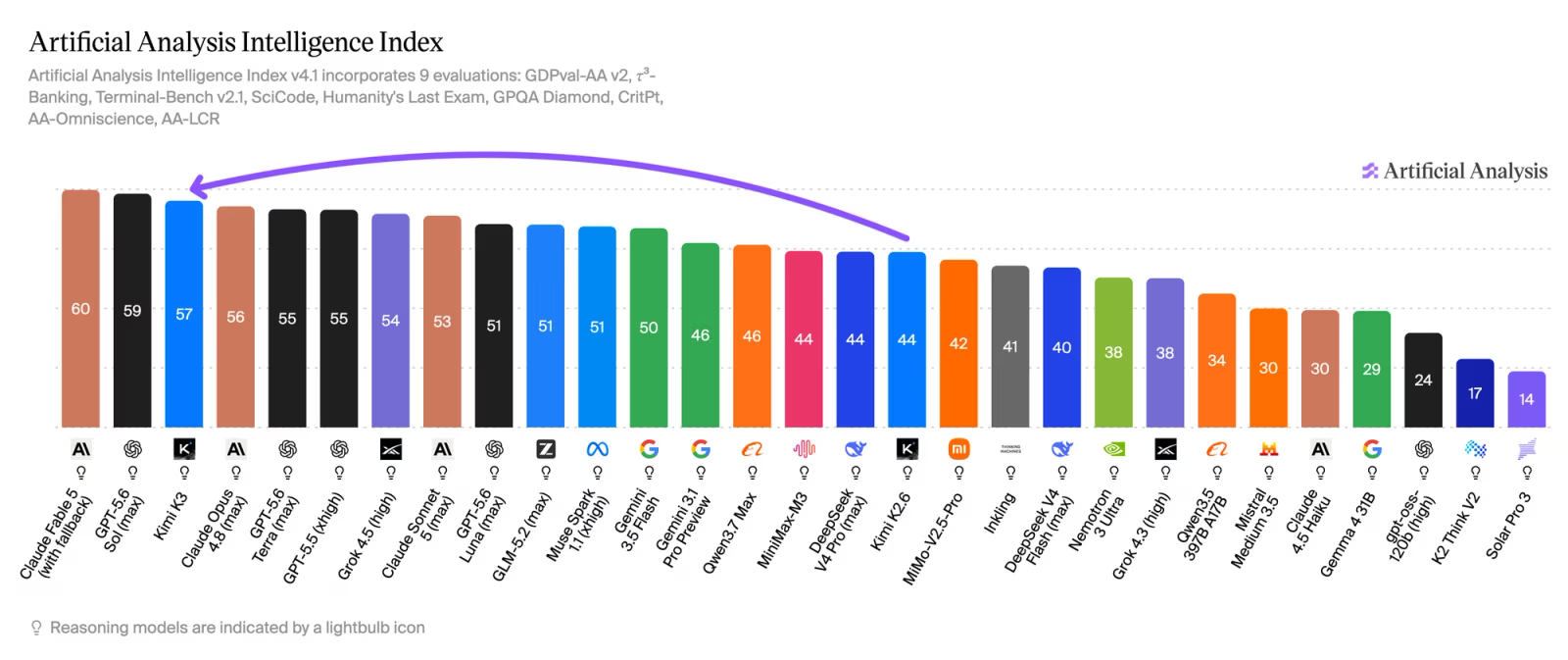
On the Artificial Analysis Intelligence Index, K3 scores 57.11 vs Fable 5's 59.86—a 2.75-point gap that positions K3 at #4 overall, ahead of Opus 4.8 (55.69).
The important caveat: all numbers are vendor-reported. Moonshot's benchmarks are "maximum thinking effort," meaning they represent best-case performance, not typical real-world usage. Independent replication hasn't happened yet. Until external testing arrives, treat these numbers as launch positioning rather than settled ground truth.
The Distillation Controversy
This is the angle no one adequately addresses. In February 2026, Anthropic accused Moonshot of running approximately 3.4 million distillation exchanges against Claude. Distillation means using Claude as a teacher to improve Kimi's performance—essentially learning from Claude's outputs to bootstrap K3's capability.
AIToolsReview notes this allegation is "directly relevant to K3's strongest category" (autonomous agentic work), where K3's benchmark gains are most pronounced.
If K3's agentic performance was partly shaped by learning from Claude, then the benchmark comparison is less a fair competitive matchup and more evidence that distillation works. That's not inherently damning—distillation is a legitimate technique—but it reframes what "K3 beats Fable 5 at coding" actually means. It may mean "K3, trained with Claude's help, outperforms Claude at specific tasks."
Moonshot has not publicly addressed this allegation. Anthropic has not pursued legal action. The controversy sits in ambiguous territory, which is precisely where skepticism belongs.
Open-Weight Changes the Competitive Game
Here's what shifts K3 from interesting to strategically significant: open-weight fundamentally changes how models compete.
Claude Fable 5 is closed. You access it via Anthropic's API. You pay per token. Your data runs through Anthropic's servers. You have no control over the model; you're renting capability.
Kimi K3 is open-weight, with full model weights promised for release on July 27, 2026. Once released, anyone can download K3 and run it on their own hardware. No API dependency. No data sharing. No per-token costs after initial infrastructure investment.
K3's pricing is $3/$15 per million input/output tokens via API—3.3x cheaper than Fable 5's $10/$50. But once you self-host, the only cost is compute. For high-volume agentic work or long-context reasoning, self-hosting amortizes quickly.
This is why open-weight models threaten closed providers. They're not just competing on capability; they're competing on control and cost structure. Moonshot isn't trying to beat Fable 5 at peak performance. It's offering an alternative that trades some performance for freedom, ownership, and lower long-term cost.
Practical Implications: When to Use Each
The verdict isn't "K3 wins" or "Fable 5 wins." It's workload-dependent.
Use Claude Fable 5 for: - Highest-stakes tasks where reliability trumps cost - Complex reasoning over ambiguous or novel problems - Visual reasoning, professional knowledge work - Teams where managed infrastructure and vendor support matter Use Kimi K3 for: - High-volume agentic workflows (routing, retrieval, browsing) - Long-context reasoning (K3's 1M token window is an advantage) - Cost-sensitive automation where 95% correctness suffices - Self-hosted deployment where API dependency is unacceptable The real win is routing. Teams that can detect task difficulty and route high-stakes work to Fable 5 while sending high-volume work to K3 get frontier capability at optimized cost. This is already happening: MorphLLM describes exactly this pattern, with K3 handling high-volume agentic work and Fable 5 handling highest-stakes tasks.
What Comes Next
July 27, 2026 is the real date that matters. That's when K3's full weights ship and become deployable locally. The conversation shifts from "Can K3 compete with Fable 5?" to "Can we self-host K3 at scale? What does that cost? How does it integrate with our infrastructure?"
Independent benchmarking will start. Real-world deployments will begin. The distillation controversy may sharpen or fade depending on whether K3's performance holds up without Claude's training influence.
Moonshot also faces questions about operational support, fine-tuning tooling, and community building that OpenAI and Anthropic have already solved. Having the weights is table stakes; making them deployable and maintainable at enterprise scale is the actual challenge.
The Bottom Line
Kimi K3 is real competition, but not in the way headlines suggest. It doesn't "beat" Fable 5 at reasoning or reliability. It offers a different value proposition: frontier-tier performance at lower cost with ownership and control.
The benchmarks are real but unproven at scale. The distillation controversy deserves attention—it may explain some of K3's performance gains more directly than architectural superiority. The open-weight strategy is the actual differentiator.
For teams where API cost is constraint and performance can trade for self-hosting complexity, K3 is genuinely useful. For teams where peak capability matters more than cost, Fable 5 remains the choice. The market is large enough for both.
Treat vendor benchmarks skeptically. Wait for independent replication. Evaluate your actual workloads rather than comparing leaderboard positions. That's where real decisions happen.
Resources
- CodersEra: Kimi K3 Benchmarks vs Fable 5, GPT-5.6, Opus 4.8: Head-to-head benchmark breakdown
- Medium: Kimi K3 vs Claude Fable 5 by Mehul Gupta: Practical workload routing analysis
- AIToolsReview: Kimi K3 vs Claude Fable 5 Full Scorecard: Includes distillation allegation context
- BenchLM.ai: Claude Fable 5 vs Kimi K3 Comparison: Live benchmark tracking
- Moonshot AI Official: Kimi K3 Technical Specifications: Architecture, parameters, training details
- Nature: "Does China's Latest AI Model Finally Equal US Rivals?": Scientific community perspective
Disclaimer
This analysis synthesizes published benchmarks from Moonshot AI, independent evaluation platforms (BenchLM, Arena.ai, CodersEra), and journalism from Bloomberg, VentureBeat, and Fortune. All performance claims are sourced from the resources listed above. Benchmark numbers are vendor-reported ("maximum thinking effort") and remain unverified by independent replication. The distillation allegation is documented by Anthropic but not publicly addressed by Moonshot. This analysis is interpretive—conclusions about strategic implications and practical applications are inferences based on observed data, not confirmed by either company. This piece is for informational purposes and should not be considered technical guidance for model selection; evaluate your own workload requirements against published benchmarks before adopting either model.