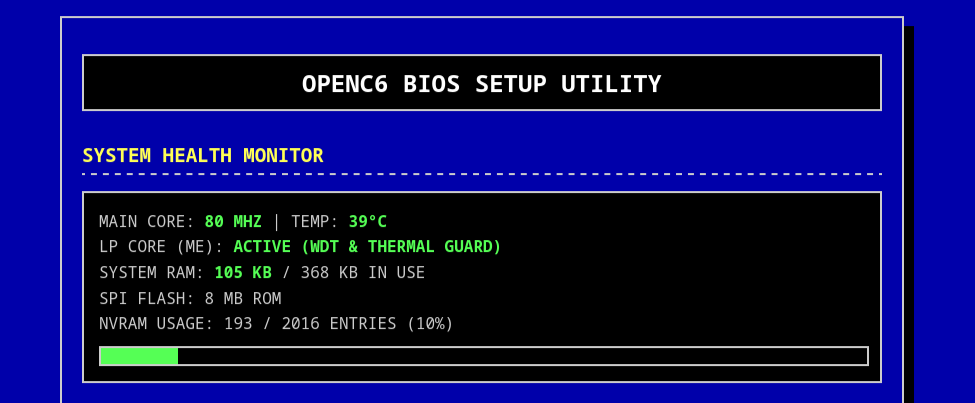
OpenC6 announced a full‑stack BIOS and microkernel for the ESP32‑C6, exposing a classic‑look configuration page at http://192.168.4.1 and supporting wireless OTA firmware updates out of the box.
Architecture Highlights
The firmware separates hardware init from user‑space execution, using RISC‑V Physical Memory Protection (PMP) to sandbox unprivileged U‑Mode payloads. An autonomous supervisor runs on the low‑power LP‑Core coprocessor, handling watchdog timeouts, temperature throttling, and power‑button events. A hardware‑backed frequency governor switches the HP core between 80, 120, and 160 MHz based on load, while the custom ZSWAP engine compresses suspended processes to reclaim RAM. All of this is documented in the OpenC6 repository.
Development Experience
A C99 TUI installer (make setup) configures the ESP‑IDF v6.1 toolchain, builds the BIOS, wipes stale partitions, and flashes the target. Developers can stream binaries over the native USB‑CDC interface with the openc6_loader utility, then launch them via the boot command, optionally in the background (boot <path> bg). Network booting is also supported: a simple HTTP server can serve .bin payloads that the BIOS fetches with pxe <url>.
Trade‑offs & Limits
OpenC6 is tightly coupled to the ESP32‑C6 hardware and requires ESP‑IDF v6.1 or later, so it isn’t a drop‑in for other MCUs. The process manager caps concurrent jobs at eight, and the PMP sandbox only blocks MMIO accesses above 0x60000000, which may need custom driver work for peripheral‑heavy designs. The project is MIT‑licensed and free to use, but the page does not list any pricing or commercial support options.
When to Try It
If your startup is building custom IoT devices that need on‑device multitasking, secure payload isolation, and over‑the‑air updates without a full OS, cloning the repo and running the automated setup wizard is a low‑cost way to evaluate the approach. Watch for future releases that expand the HAL layer to other RISC‑V targets.