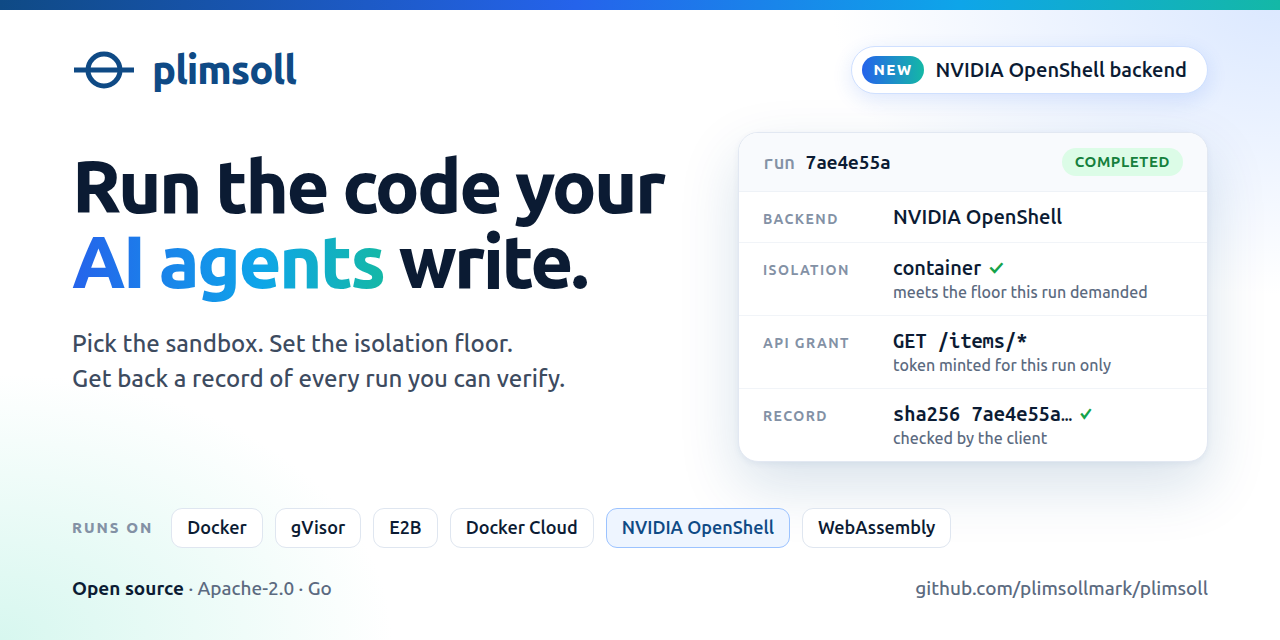
plimsoll, an open‑source sandbox service, now lets you run untrusted, agent‑generated code and forces the daemon to report the isolation tier it actually used – process, container, kernel, or vm – while allowing callers to set a MinimumIsolation floor. A minimal example using the built‑in wasm provider finishes in 304 ms and reports the process tier.
Tiered isolation you can verify
Each run returns an Isolation field indicating the concrete boundary the code executed behind. Callers can require a floor, for instance MinimumIsolation: sandbox.IsolationVM; if the daemon cannot meet that tier it returns ErrInsufficientIsolation and nothing runs. The four tiers are defined in the repo’s docs, from weakest (process) to strongest (vm) plimsoll.
Credential‑less API calls via grants
plimsoll’s broker mints a short‑lived credential per run and injects it only when the sandbox makes an outbound API call. The code inside the sandbox never sees the token or the API address, and a missing grant blocks any network access. Grants can be scoped to specific routes, letting you expose only the endpoints an agent needs.
Flexible back‑ends for different threat models
The daemon can switch providers via SANDBOX_PROVIDER: wasm (QuickJS on wazero) for fast local development, docker with runc for container‑level isolation, docker with runsc (gVisor) for kernel‑level protection, and hosted microVMs (E2B, Docker Cloud, OpenShell) for full VM isolation. Providers that run on your own machine (process, container, kernel) keep state in a session, while the VM providers run on external hosts and bill per run.
Caveats to consider
The isolation tier is evidence collected by the daemon, not cryptographic attestation from hardware, so a compromised host could still lie about the tier. The default process tier offers no OS‑level wall, making it unsuitable for hostile code. The project does not publish pricing for the hosted VM providers, so cost estimation requires contacting the vendors directly.
What to watch – Try the wasm provider for quick local testing (no Docker needed) and set a MinimumIsolation floor that matches your risk tolerance. When you need stronger guarantees, experiment with the runsc (gVisor) or a hosted VM provider, and monitor the Isolation field to confirm you’re getting the expected protection level.