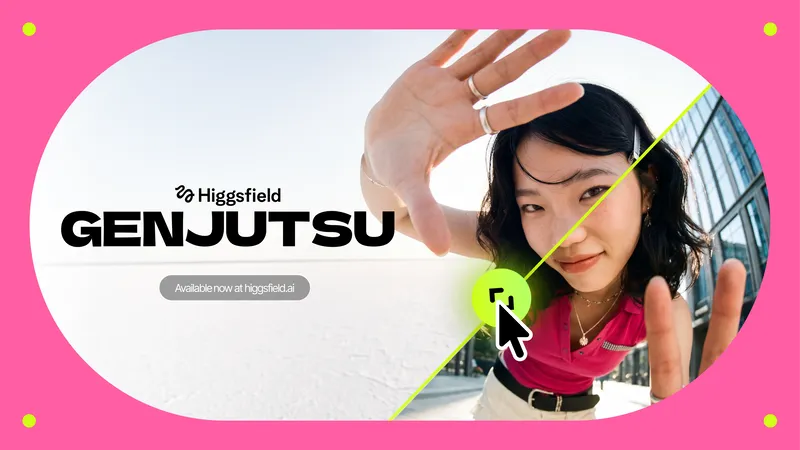
Founders who produce short-form video often spend hours reshooting or re-editing clips to change a character, setting, or movement. Higgsfield's Genjutsu model handles part of that work: it takes the motion from one video and applies it to a new character or rebuilt scene, keeping the rest of the footage. The API is available now, with a 50% discount that Higgsfield's announcement lists as running through October 31. Whether it fits your pipeline depends on three numbers: cost per second, input limits, and turnaround time, which Higgsfield does not publish.
What Genjutsu Actually Does
Genjutsu has two modes. Motion Transfer takes movement from an existing video and applies it to a new character or rebuilt scene. Object Swap replaces one specified element while the rest of the original footage stays as filmed. Neither mode needs a prompt, though a short description is optional.
The API works on one source video and up to eight reference images. Each request sends a public video URL, 1 to 8 image URLs, and an optional prompt. Output resolution is 480p, 720p, or 1080p. Source clips must be at least 4 seconds, and anything longer than 30 seconds is trimmed. The API documentation lists these limits, along with the endpoint and request format.
Requests are asynchronous. You submit a job, receive a status URL, and poll until the status reads completed, or use webhooks. The completed response includes a link to the generated video. The docs do not state how long a job takes.
Cost: What You Actually Pay
The API bills per second of video. Higgsfield's pricing page lists Genjutsu motion transfer from $0.318 per second at list price, or $0.159 per second at the maximum 50% discount. Prices are shown as "from" amounts, so the exact cost depends on the settings you choose.
Worked examples at the listed rates: - 15-second clip: about $4.77 at list, about $2.39 at the discount - 30-second clip (the maximum): about $9.54 at list, about $4.77 at the discount These figures are per second of output, so they exclude any extra cost of images or retries. The consumer app shows credit costs by resolution, and those figures differ from the API rates, so check the rate shown in your console before budgeting.
The 50% discount has a stated end date, but the pricing page does not show one. The October 31 date comes from Higgsfield's launch post on X. Confirm it in your account before you plan a campaign around it.
Speed: The Gap Nobody Publishes
Turnaround time is the biggest unknown. Higgsfield's documentation and pricing pages give no generation time. A Kavel review of the consumer app reports that the company does not publish processing times, and that some users have waited multiple days for renders. Those are user reports, not measured benchmarks.
So the practical test is simple. Submit 10 representative clips, time each one from submission to completed status, and measure the median and worst case. Only then can you say whether Genjutsu fits a daily publishing schedule or only a planned campaign.
Where Genjutsu Fits in a Content Pipeline
The API slots in as one step, not a full pipeline. It produces a re-cast video from your source clip and reference images. Voiceover, captions, and publishing still happen in separate tools, and Higgsfield does not document native connectors for Zapier or Make.com.
Use Genjutsu if: - You already have source footage and need the same movement applied to different characters, products, or settings - You produce ad variations or style swaps where reshooting is the expensive option - Your team can absorb asynchronous jobs and polling in your workflow Skip Genjutsu if: - You need video generated from a text prompt with no source footage (a text-to-video tool is the better fit) - You need predictable same-day turnaround, since the published information does not support that promise - Your clips run past 30 seconds, since they get trimmed
How It Compares to Other Video Tools
Genjutsu's input model is different from text-to-video tools. Genjutsu starts from footage you already have. Text-to-video tools start from a prompt. That is the main decision point, and it matters more than any feature list.
I could not verify competitor pricing from primary sources in this review. Runway's pricing page and the costbench listing I checked did not give a per-second rate, so any cost comparison with Runway, Pika, or Synthesia needs a direct check on each vendor's pricing page before you publish one.
A Decision Framework for Founders
Use Genjutsu if you have a library of usable footage, you need variations of the same movement, and you can accept asynchronous delivery.
Use a text-to-video tool if you have no source footage and need new scenes from scratch.
Wait before committing if your publishing schedule depends on same-day renders. Run the 10-clip timing test first.
Bottom Line
Genjutsu is a motion-transfer API with clear per-second pricing and documented limits. At the listed rates, a 15-second clip costs about $2.39 with the discount. The pricing, input limits, and API access are verified. The turnaround time is not published, and the October 31 end date comes from Higgsfield's post rather than the pricing page.
If you produce many short clips from footage you already own, the cost is low enough to test properly. Run the timing test before you build a schedule around it.
Explore More on Automation Opportunities
Bitroot's blog library covers emerging AI adoption across industries—how founders navigate regulatory shifts, liability gaps, and cost automation. Check it for ongoing analysis on automation opportunities in your space.