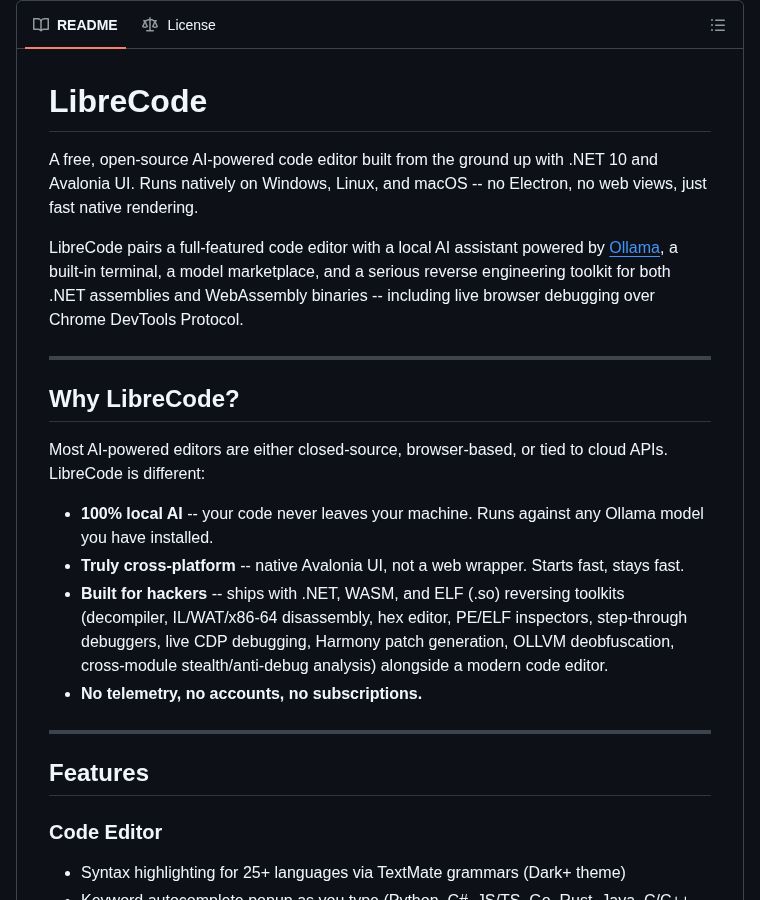
LibreCode, an open‑source AI‑assisted editor, hit version 1.0 and runs entirely on the developer’s machine, eliminating the $20/month cloud subscription that many competing tools charge. The announcement came from Zane Chen on X tweet.
Full‑stack local tooling
Built on .NET 10 with a native Avalonia UI, LibreCode avoids the Electron overhead that inflates memory usage in similar editors. It ships with a .NET decompiler, WASM disassembly, live browser CDP debugging, and an OLLVM deobfuscator, turning the IDE into a reverse‑engineering workstation out of the box. Because the UI is compiled to native code, typical memory footprints sit around 300 MB, roughly half of what an Electron‑based AI editor reports, and the binary runs on Windows, macOS, and Linux.
Privacy‑first model execution
The editor delegates inference to Ollama, a locally hosted LLM runner, so source files never leave the workstation and no telemetry is sent. No analytics are shipped, and the binary does not prompt for sign‑in, eliminating the risk of accidental data exfiltration. This design matches teams that must keep proprietary code behind firewalls.
Trade‑offs and limits
Running models locally demands a GPU or a powerful CPU; on modest laptops inference can be slow, and model updates rely on the user to pull newer Ollama containers. Only models that Ollama provides in a compatible format can be used; many popular proprietary models remain unavailable without a separate license. The bundled toolkit is impressive but focuses on .NET and WebAssembly, so languages outside that ecosystem receive less support.
Cost and adoption
LibreCode is free and open source under an MIT‑style license, with no account required. Startups can clone the repo and start editing without budgeting for recurring SaaS fees, but they must allocate developer time to install Ollama and manage model files. The project is actively maintained; contributors have added support for recent .NET 10 language features, but the roadmap is community‑driven, so enterprise‑grade SLAs are absent.
What to watch: monitor the Ollama model catalog for performance‑optimized releases, and consider LibreCode for any internal tooling where code confidentiality outweighs the convenience of cloud‑based AI assistants. If your team already runs Ollama for other tasks, adding LibreCode is a low‑friction experiment.